


ResComm 2025: Bringing Research Into Action — A Conversation with Dr. Shantanu Ganguly
- Ashoka Library
- Dec 11, 2025
- 7 min read
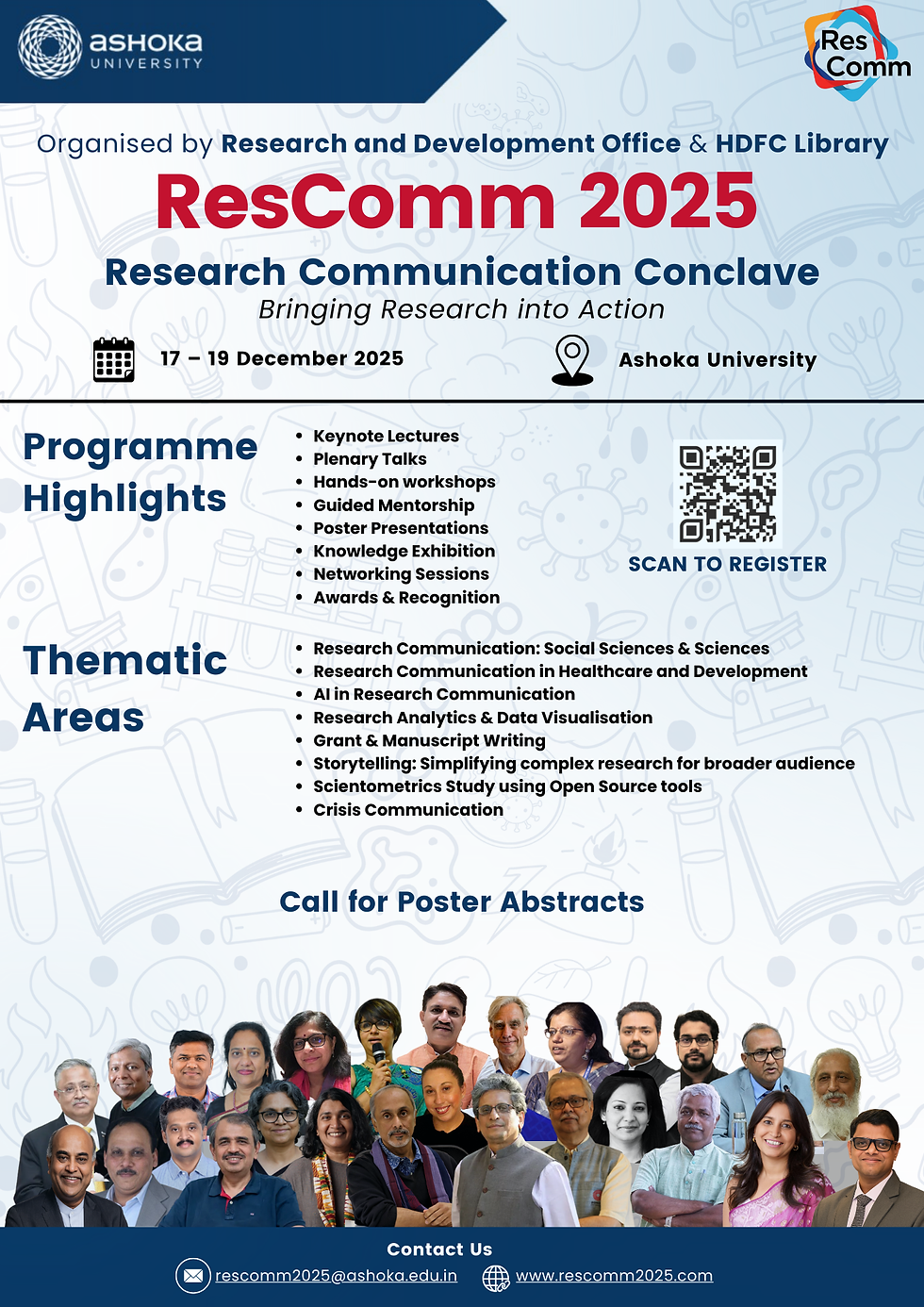
ResComm 2025 is around the corner. The Research Communication Conclave is scheduled for 17-19 December at Ashoka University campus. The conclave is organised by the Research and Development Office and HDFC Library at Ashoka University. It aims to bring research into action and brings together expats from the fields of research (sciences and humanities), industry and communications. The scholars, early career researchers, experts in their fields and faculty members will be attending the conclave and sharing knowledge. To give you an in-depth view of the conclave, we bring you a conversation with Dr. Shantanu Ganguly, Director of Library Operations at Ashoka University.
Q1. Why a Research Communication Conclave? What inspired you to organise ResComm 2025? What is the vision of this conclave, and what does it aim to accomplish?
Answer: Research today is no longer confined to academic journals or closed circles of scholars—it has the power to influence policy, industry, communities, and society at large. Yet, a significant gap exists between the knowledge generated in research institutions and its communication to wider audiences in accessible, engaging, and impactful ways. This gap often results in missed opportunities for collaboration, innovation, and public trust in science.
The Research Communication Conclave (ResComm 2025) was envisioned to address this pressing need. We were inspired by the realization that while research in India and globally is thriving, the art and science of communicating it effectively—whether through digital platforms, policy briefs, storytelling, or multimedia formats—has not received adequate attention.
Our vision is to create a vibrant platform where scholars, practitioners, policymakers, communicators, and innovators come together to reimagine research communication in a holistic manner. The conclave seeks to:
Bridge the gap between academia and society through innovative communication practices.
Empower researchers with tools and skills to showcase their work beyond traditional formats.
Showcase best practices in conventional and digital dissemination of research.
Foster collaborations among institutions, industry, and media for amplifying research impact.
Celebrate and recognize innovative research communication efforts through posters, workshops, and interactive sessions.
Ultimately, ResComm 2025 aims to build a culture where research is not only produced but also shared, understood, and acted upon. It is about positioning communication as central to the research ecosystem—ensuring that knowledge serves people, inspires change, and contributes to solving real-world challenges.
Q2. The fact that ResComm 2025 brings together participants from diverse and interdisciplinary backgrounds, what impact do you envision the conclave will create both in the short term and long term?
Answer: The strength of ResComm 2025 lies in its diversity. By convening researchers, communicators, policymakers, industry leaders, media professionals, and students on a single platform, the conclave encourages cross-pollination of ideas that extend far beyond disciplinary boundaries. This interdisciplinary convergence is expected to yield a series of significant outcomes.
In the short term, the conclave will:
Foster dialogue and exchange, enabling participants to understand the varied challenges and opportunities in research communication across fields.
Showcase innovative practices, offering researchers and institutions actionable strategies they can immediately adopt for wider visibility and societal engagement.
Strengthen networks and collaborations, opening pathways for joint projects, policy consultations, and institutional partnerships.
Enhance capacity building through workshops, poster sessions, and demonstrations that equip participants with practical skills.
In the long term, the impact will be more systemic and transformative. ResComm 2025 aspires to:
Cultivate a sustained culture where research communication is embedded into the very fabric of academic and research institutions.
Influence policy and funding priorities, positioning communication as a vital criterion for research evaluation and support.
Build a new generation of scholar-communicators, who are adept not only at generating knowledge but also at ensuring it reaches diverse stakeholders.
Establish India’s leadership in shaping global best practices in research communication, thereby strengthening the international visibility of Indian scholarship.
In essence, the conclave’s interdisciplinary approach is designed to create both immediate actionable outcomes and a lasting transformation of the research ecosystem—ensuring that knowledge transcends silos and contributes to meaningful societal progress.
Q3. With technological advances and a shift in how people consume information, there’s a need for an upgrade in how research is communicated. What is your take on this? Share with us some innovative communication methods you have observed that are making their mark in the present research ecosystem.
Answer: The landscape of communication has undergone a profound transformation. With digital technologies, social media platforms, and immersive tools reshaping the way knowledge is shared and consumed, research communication can no longer rely solely on conventional publications or academic conferences. The challenge before us is not merely to simplify research, but to reimagine how it is packaged, disseminated, and experienced.
Today, audiences demand accessibility, brevity, and interactivity. To meet this shift, we are witnessing several innovative approaches that are redefining the research ecosystem:
Visual storytelling and data visualization: Infographics, dynamic dashboards, and interactive maps are making complex findings more accessible to non-specialist audiences.
Short-form digital content: Video explainers, podcasts, and research reels are emerging as powerful tools to reach policymakers, industry, and the public.
Open science platforms and preprint servers: These allow faster and wider circulation of knowledge, breaking traditional publishing barriers.
Immersive technologies (AR/VR/XR): Virtual labs, simulations, and interactive exhibitions are transforming the way research impact is experienced.
AI-driven communication tools: From automated lay summaries to personalized knowledge feeds, artificial intelligence is helping bridge the gap between research outputs and diverse audiences.
At its core, the shift reflects a move from one-way dissemination to dialogue and engagement. The most successful innovations are those that humanize research, foster inclusivity, and position knowledge as a shared public good.
ResComm 2025 builds upon this very spirit—bringing together the best practices and future possibilities to ensure research speaks to, and for, society.
Q5. What are the advanced digital tools and platforms available at Ashoka University to help researchers carry out their research effectively, but also communicate it with equal impact?
Answer: At Ashoka University, we recognize that impactful research goes beyond discovery—it must also be communicated effectively to reach diverse audiences and create meaningful change. To support this dual objective, the University has invested in a comprehensive digital ecosystem that enables both rigorous research and dynamic dissemination.
On the research front, faculty and students have access to:
State-of-the-art digital databases and repositories providing global scholarly resources across disciplines.
Advanced data analysis and visualization tools that enable cutting-edge research design, modeling, and interpretation.
Research management platforms that streamline project workflows, compliance, and collaboration.
Equally important, on the communication front, Ashoka provides:
Institutional repositories and open-access platforms to ensure wider visibility and long-term preservation of scholarship.
Digital publishing tools and platforms for creating policy briefs, working papers, and knowledge products.
Multimedia and design facilities supporting infographics, videos, podcasts, and other creative formats for research storytelling.
Training workshops on digital communication, science writing, and public engagement to build researcher capacity.
Together, these resources create a holistic environment where research at Ashoka is not only produced with academic rigor but also communicated with clarity, creativity, and global impact.
Q4. How are libraries facilitating effective research communication and enhancing the visibility of research?
Answer:Libraries have evolved from being mere repositories of knowledge to becoming active enablers of research visibility and impact. In today’s digital-first environment, they serve as strategic partners in the research lifecycle, ensuring that scholarship is not only preserved but also communicated effectively to diverse audiences.
Libraries facilitate research communication in several keyways:
Institutional Repositories & Open Access Platforms: By hosting and disseminating research outputs, libraries increase global discoverability and ensure long-term accessibility.
Support for Publishing & Compliance: Libraries guide researchers on copyright, licensing, and open-access mandates, helping them align with global standards while maximizing reach.
Digital Tools & Data Services: Through bibliometrics, altmetrics, and citation analysis, libraries help measure research impact and provide visibility strategies.
Knowledge Products & Showcasing: Libraries curate research newsletters, exhibitions, digital showcases, and policy briefs, translating complex findings into accessible formats.
Capacity Building: Many academic libraries train researchers in scholarly communication, data management, and effective use of digital platforms.
By combining curation, capacity building, and communication support, libraries now play a pivotal role in ensuring that research is visible, accessible, and influential within both academic and public domains.
Q6. In today’s world of digital learning and knowledge sharing, the library’s role has expanded beyond being a repository of books. How do you envision Ashoka University’s library evolving into a dynamic space for research and collaboration, and supporting the communication of research?
Answer:At Ashoka University, we view the library not as a static storehouse of books but as a living knowledge ecosystem—a space where discovery, collaboration, and communication converge. As research becomes increasingly interdisciplinary and digitally driven, the library is poised to evolve into a hub of innovation and engagement that extends far beyond its traditional role.
We envision the Ashoka library as a:
Collaborative Knowledge Space: Offering flexible, technology-enabled environments where researchers, students, and faculty can co-create and exchange ideas.
Digital Gateway: Providing seamless access to global scholarly databases, e-resources, and advanced data visualization tools.
Research Communication Partner: Supporting the creation of policy briefs, multimedia content, digital showcases, and open-access dissemination of Ashoka’s scholarship.
Capacity Builder: Training the academic community in digital literacy, scholarly communication, and public engagement.
Innovation Showcase: Hosting exhibitions, hackathons, and poster sessions that make research visible and accessible to wider audiences.
By integrating these functions, the Ashoka library aspires to become a dynamic center for research, collaboration, and communication—where knowledge is not only preserved but also activated, amplified, and shared with society.
Q7. What message would you like to give to the potential participants of the conclave? What outcomes and learnings do you hope they will take away from ResComm 2025?
Answer: My message to all potential participants is simple yet profound: your research deserves to be seen, heard, and understood. ResComm 2025 is not just a conference, but a collaborative platform to rethink how knowledge is communicated and how it can create a deeper impact beyond academic circles.
We hope participants will take away three key outcomes from this conclave:
Practical skills and strategies—new tools, methods, and approaches to make research more engaging and accessible through digital, visual, and narrative formats.
Collaborative networks—opportunities to connect with peers, policymakers, communicators, and industry leaders, fostering partnerships that amplify the reach and relevance of research.
A renewed perspective—an understanding that research communication is not an add-on, but a vital part of the research journey that drives societal trust, policy influence, and innovation.
ResComm 2025 is a call to action: to embrace communication as a bridge between scholarship and society. We invite participants to be part of shaping this culture—where research is not only produced, but also shared, celebrated, and transformed into meaningful change.
Author:
Dr. Shantanu Ganguly
Director, Library Operations
Ashoka University

Comments